
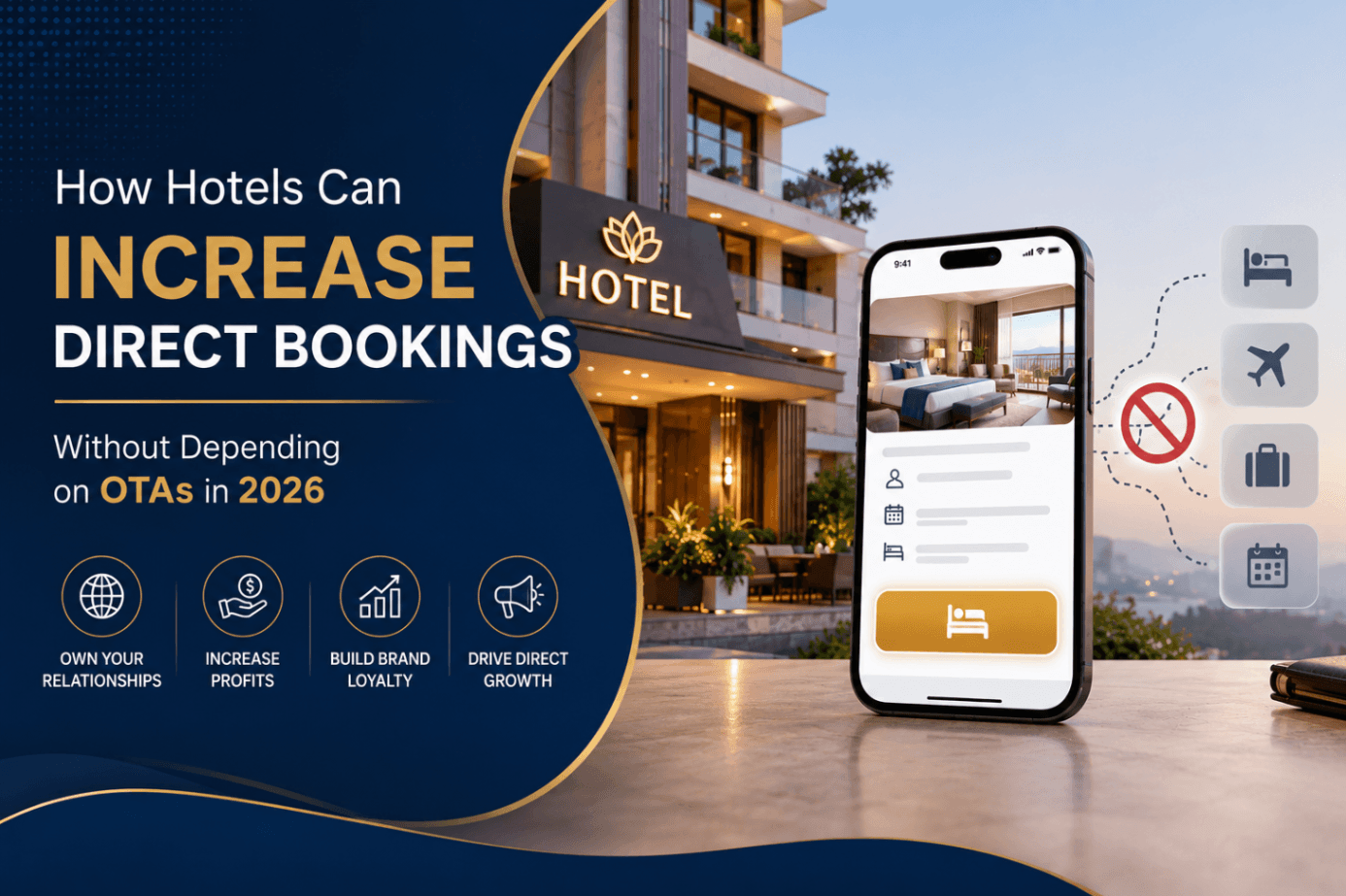
How Hotels Can Increase Direct Bookings Without Depending on OTAs in 2026
Learn why hotels stay full through OTAs but earn little through their own website — and the exact steps to build a stronger, more profitable direct booking channel in 2026
Booking rooms, but not through your own website? Find out exactly why — and fix it. Get Free Audit
A hotel can be fully booked and still be in trouble
It’s one of the most common patterns in hospitality: occupancy looks healthy, rooms are filling up, revenue is coming in — but almost all of it is arriving through OTAs. The hotel’s own website, the channel with the highest margin and the most control, barely converts a handful of bookings a month.
This isn’t a visibility problem or a “the industry is changing” problem. It’s a structural one: the direct-booking channel was never built to actually compete with OTAs for the guest’s attention and trust. Guests find the hotel, sometimes even browse the hotel’s own website — and still end up booking through Booking.com or Expedia anyway.
This article breaks down exactly why that happens, what it costs a hotel in real revenue, and the specific, practical steps to build a direct booking channel strong enough to stand on its own — without cutting OTAs out entirely
Why Direct Bookings Matter for Hotel Revenue
Every booking that comes through an OTA carries a commission — typically 15% to 25% per reservation. On a room that would net ₹5,000 a night directly, an OTA booking can quietly cost ₹750–₹1,250 of that before any other expense is even counted.
Beyond the commission itself, direct bookings give a hotel something OTAs never will:
None of this means OTAs are the enemy. It means every booking that could have gone direct but didn’t is quiet, repeated revenue loss
Direct Bookings vs OTA Bookings
Direct Bookings
Commission :- None (or minimal payment processing fee)
Guest data ownership :- Full — email, preferences, history
Guest relationship:- Owned by the hotel
Pricing flexibility:- Full control
Reach & discovery:- Depends on hotel’s own SEO/marketing
Repeat booking potential:- High, if guest data is used well
OTA Bookings
Commission:- 15–25% per booking
Guest data ownership:- None or very limited
Guest relationship:- Owned by the OTA
Pricing flexibility:- Often restricted by rate parity clauses
Reach & discovery:- Very high — OTAs invest heavily in traffic
Repeat booking potential:- Low — guest often rebooks via OTA again
The takeaway isn’t “direct is always better.” It’s that OTAs are excellent for discovery, and direct is where the actual profit and relationship live — which is exactly why both channels need to work, not just one.
How OTA Dependency Can Affect Hotel Revenue
When a hotel relies on OTAs for the large majority of its bookings, a few risks compound quietly over time:
None of these are dramatic on their own. Together, over a year, they quietly define whether a hotel is genuinely profitable or just consistently busy
Should Hotels Stop Using OTAs?
No — and that’s not the goal. OTAs bring genuine value, especially for:
The real goal isn’t eliminating OTAs. It’s reducing dependency — building a direct channel strong enough that OTAs become one healthy source of bookings among several, rather than the only one keeping the hotel afloat.
Why Travelers Choose OTAs Instead of Booking Directly
Even guests who find a hotel’s own website often still book through an OTA. Here’s why:
Poor SEO Visibility
If a hotel doesn’t rank well for its own name or relevant local searches, the OTA listing often outranks the hotel’s own website — meaning even loyal, returning guests end up clicking through an OTA out of habit.
Weak Website
An outdated, cluttered, or slow website signals — fairly or not — that the property itself might be dated too. Guests trust what feels current and well-maintained.
No Direct-Booking Value
If the price and inclusions are identical on both the hotel’s website and the OTA, there’s no reason for a guest to choose one over the other. Without a clear incentive, habit wins — and habit usually means the OTA.
Poor Google Business Profile
An incomplete profile, outdated photos, missing booking link, or few recent reviews pushes guests toward the OTA listing that appears more complete and current.
Booking Friction
A multi-step, confusing, or slow booking process on the hotel’s own site — compared to the familiar one-click flow of an OTA app — is often enough to lose the booking entirely.
Weak Trust
Guests hesitate to enter card details on an unfamiliar hotel website with no visible security signals or reviews, when an OTA offers built-in buyer protection and dispute resolution.
No Remarketing
A guest browses the hotel’s website, gets distracted, and leaves without booking. Without a retargeting ad or follow-up email, that guest simply books elsewhere later — usually through an OTA that remembered them via its own app
8 Ways Hotels Can Increase Direct Bookings
Hotel SEO
Target the searches guests actually use — hotel name, location-based terms, and specific trip intents (business, weekend, family). Ensure fast load times, structured data (schema) for room types and pricing, and dedicated content pages rather than a single generic homepage.
Conversion-Focused Website
Design around one goal: getting to the booking button. Clear CTAs, visible pricing, trust signals (reviews, secure payment icons) placed near the booking flow, and a mobile-first layout, since most guests browse and book on their phones.
Google Business Profile
Keep it fully complete and current — accurate categories, updated photos, direct booking link, and prompt responses to reviews and questions. This is often a guest’s first real impression, before they ever reach the website.
Direct Booking Offers
Give guests an actual reason to skip the OTA: a small discount, complimentary breakfast, late checkout, or a welcome amenity — reserved exclusively for bookings made directly.
Reviews
Actively request reviews from happy guests and respond to all of them, positive or negative. Recent, detailed reviews build trust and also help visibility in both traditional and AI-driven search.
Booking Experience
Reduce the steps between “interested” and “booked.” Auto-filled fields, multiple payment options, instant confirmation, and a mobile-optimized flow all reduce the moments where a guest might abandon and switch to an OTA instead.
Digital Marketing
Use retargeting ads for website visitors who didn’t book, email marketing to past guests, and social media to keep the hotel visible between trips — so the hotel, not the OTA, is top of mind when the guest is ready to book again.
Analytics
Track direct vs. OTA booking ratios, monitor where guests drop off in the booking flow, and use that data to continuously refine the website and offers rather than guessing what isn’t working.
Hotel Direct Booking Funnel
A simple way to see the full journey:
Most hotels only focus on stage 1. The biggest, cheapest revenue gains usually come from fixing stages 3 and 4.
Location-Based Hotel SEO
A large share of hotel searches are inherently local — “hotels near [landmark],” “[city] hotel with pool,” or simply searched while already in or near the destination. To win these:
Direct Booking Checklist
A quick reference to audit your own hotel:
[ ] Website loads in under 3 seconds on mobile
[ ] Booking flow takes 3 steps or fewer
[ ] Direct booking price/value beats or matches OTA listings
[ ] Google Business Profile is complete with a working booking link
[ ] Recent reviews (within the last 30–60 days) are visible on-site
[ ] Email list exists and is used for remarketing
[ ] Retargeting ads are active for website visitors who didn’t book
[ ] Direct-booking-only perks are clearly advertised
Is Your Hotel Too Dependent on OTAs?
Ask honestly:
If any of these answers are uncertain or uncomfortable, the dependency is likely higher than it should be — and it’s fixable.
Find Out Exactly How OTA-Dependent Your Hotel Really Is — Free
Trisage Marketing will review your website, booking flow, Google presence, and OTA-to-direct ratio, and hand you a clear, practical breakdown of what’s costing you direct bookings — and what to fix first.
Get Your Free OTA-Dependency & Direct Booking Audit →