
In-House Hotel Marketing vs Agency: What Is Better for Hotels?
Is an in-house hotel marketing team really cheaper? Compare the costs, skills and results of in-house marketing vs a hotel marketing agency.
Let us begin with a situation we see surprisingly often.
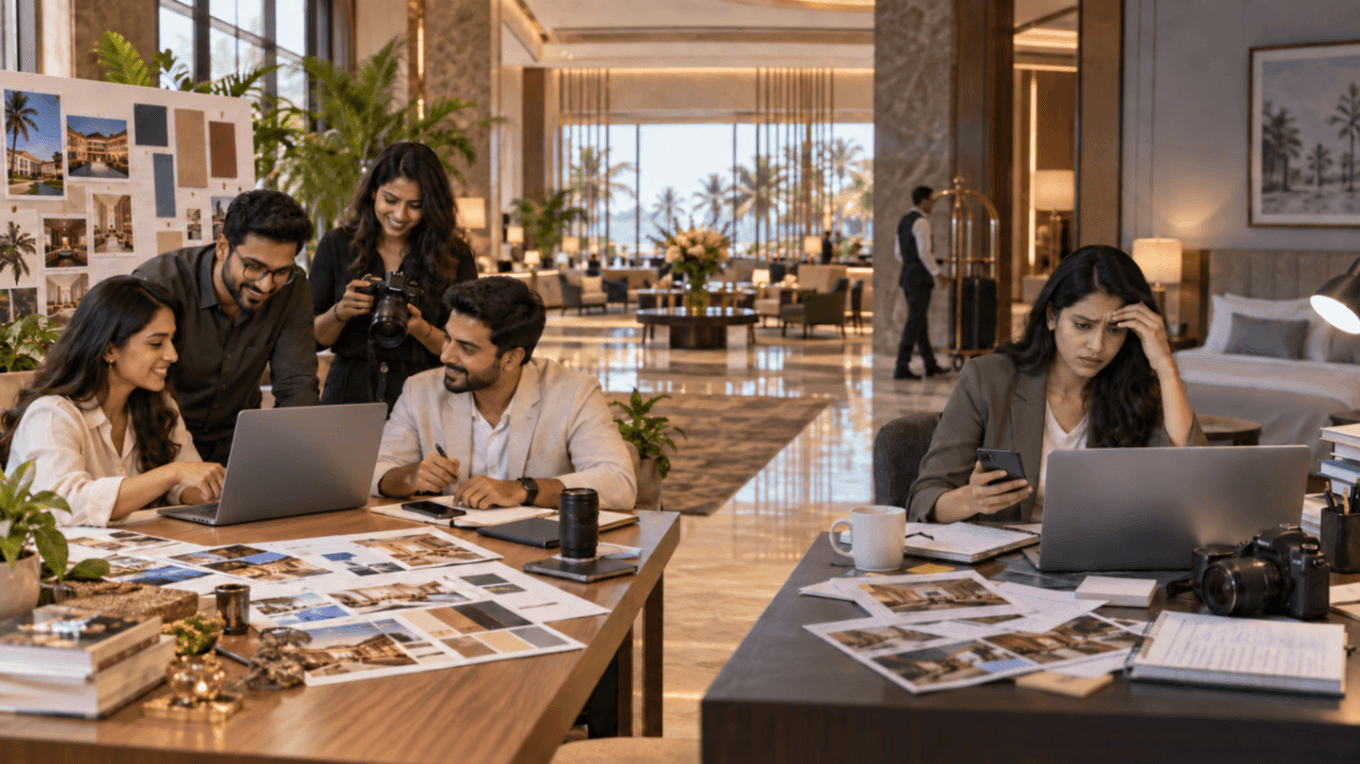
A hotel hires one marketing executive. By the end of the first week, that person is expected to manage Instagram and Facebook, design posts, shoot reels, run Google and Meta ads, coordinate with influencers, update the website, improve Google rankings, reply to reviews and somehow generate bookings too.
On paper, the hotel now has an “in-house marketing team.”
In reality, it has one person doing the work of an entire department.
This is becoming increasingly common across independent hotels and resorts. Many hotel owners believe bringing marketing in-house will save money, speed up work and give them more control. These are fair expectations. After a disappointing experience with an agency, managing everything internally can feel like the safest option.
But there is one important question that often gets missed:
Is your in-house team simply keeping your social media active, or is it actually helping you increase hotel bookings and revenue?
Because those are two very different things.
Why Are Hotel Owners Moving Marketing In-House?
The attraction is easy to understand. An employee sitting at the property can coordinate quickly, understand what is happening every day and capture content whenever required. There is no waiting for an external team to respond, and the hotel feels it has closer control over its brand.
There is also the belief that one monthly salary will cost less than hiring a hotel marketing agency.
Sometimes, it does. But only when the comparison is based on cost rather than capability.
One employee may cost less than an agency retainer. However, one employee usually cannot replace a strategist, designer, content creator, video editor, SEO expert, paid-ad specialist, website manager, influencer coordinator and revenue professional.
That is where the “in-house is cheaper” calculation begins to fall apart.
Hotel Marketing Is No Longer Just Social Media
Many hotels still use “marketing” and “social media” as if they mean the same thing. They do not.
Social media marketing for hotels is important, but it is only one part of the guest’s booking journey. A traveler may discover your resort through a reel, search for it on Google, check its reviews, visit the website, compare the rate with an OTA and then leave because the booking process feels confusing.
If your team is only posting content, who is improving the rest of that journey?
Effective digital marketing for hotels can include:
Brand positioning and campaign strategy
Professional photography and video production
Instagram, Facebook and short-form video content
Google Ads and Meta Ads
Hotel SEO services and local SEO
Google Business Profile management
Website design and conversion optimization
Online reputation management
Email and WhatsApp marketing
Influencer and PR collaborations
Offer and package development
Revenue management and channel strategy
Direct-booking tracking and analytics
Expecting one generalist to perform every one of these jobs well is not efficient. It is simply unrealistic.
The Hidden Cost of Building a Hotel Marketing Team In-House
When owners calculate the cost of in-house hotel marketing, they usually begin with salary. But salary is only the visible cost.
A complete internal setup may also involve:
Recruitment and onboarding
Graphic design and video-editing software
SEO and analytics tools
Camera and production equipment
Freelance photographers and videographers
Training and skill development
Paid advertising expertise
Website maintenance support
Time spent by management reviewing and correcting work
Replacement and handover costs when an employee leaves
The hotel may begin with one employee to save money and then hire freelancers whenever specialist work is needed. Soon, the owner is managing multiple people, approvals and payments—without having one clear strategy connecting everything.
The right comparison is not one employee’s salary versus one agency’s fee.
It is the total cost of accessing the same skills, tools, production quality and strategic support through both models.
Where Small In-House Hotel Marketing Teams Usually Struggle
1. One person becomes the entire marketing department
Hotel operations move quickly. There is always a new offer, a weekend event, an urgent wedding requirement or a room category that needs promotion.
When one person handles everything, urgent posts take priority. Long-term work—hotel SEO, website improvement, campaign analysis, database marketing and direct-booking strategy— keeps getting delayed.
The social media calendar may be completed, but the hotel’s actual marketing system does not grow
2. Content starts looking repetitive
After a few months, many hotel pages begin repeating the same pool shot, room walkthrough, food carousel and facade image. The content is regular, but the storytelling becomes predictable.
A hospitality marketing agency works across different audiences, destinations and property types. That broader exposure helps bring fresh campaign ideas, formats and creative direction to a hotel—provided the agency takes the time to understand the individual brand.
3. Specialist work becomes basic execution
This happens more often than most owners realise:
Hotel SEO becomes adding keywords to occasional blogs.
Performance marketing becomes boosting Instagram posts.
Influencer marketing becomes inviting anyone with a large following.
Revenue management becomes offering a discount whenever occupancy falls.
Website management becomes changing a banner once every few months.
All these activities may look like work is happening. But without expertise and measurement, they may not improve enquiries, direct bookings or revenue.
4. Everything depends on one employee
What happens when the marketing executive is on leave or resigns?
Content pauses. Passwords are difficult to locate. Ad campaigns lose continuity. Design files remain on personal systems. The next hire has to understand everything from the beginning.
A structured hotel digital marketing company usually has shared access, documented processes and multiple team members. This reduces the risk of the entire marketing function depending on one person.
5. The team becomes too close to the property
An internal team knows the property well, which is valuable. But being too close can make it difficult to see what a potential guest sees.
The hotel may be proud of its rooms, lawn and swimming pool—but so are its competitors. An outside team can look at the brand more objectively and ask:
Why should a guest choose this hotel over another?
Is the offer genuinely attractive or simply discounted?
Does the website make the property look trustworthy?
Is the booking journey easy?
Does the content speak to the right audience?
Is the hotel visible when people actively search for a stay in the destination?
That outside perspective often uncovers gaps an internal team has become used to.
6. Marketing and revenue work separately
This is the biggest issue.
The marketing team is focused on reach, engagement and content. The reservations team is focused on enquiries. The revenue manager is focused on occupancy, ADR and inventory. The sales team is chasing weddings, groups and corporate business.
But who is bringing all four together?
A hotel does not need a high-performing reel for a date that is already sold out. It may need a targeted campaign for low-demand weekdays, a direct-booking offer for repeat guests or wedding lead generation before the next booking season.
Hotel marketing should respond to business needs, not just festival dates and trending audio.
What Does a Hotel Marketing Agency Actually Bring?
A good hotel marketing agency is not simply an external social media team. It should operate as an extension of the hotel’s commercial function.
Consider a resort that is seeing weak occupancy for the next three weeks. Posting “Book Now” with a flat discount is not a complete strategy.
A connected approach would look like this:
Review occupancy, booking pace, room rates and target segments.
Identify whether the opportunity is couples, families, corporate groups, weddings or local staycations.
Build a package that creates value without unnecessarily reducing the room rate.
Produce content around the experience, not only the offer price.
Run Google and Meta campaigns for relevant audiences.
Improve visibility through hotel SEO and Google Business Profile.
Direct users to a clear landing page, WhatsApp flow or booking engine.
Track qualified leads, bookings, revenue and return on ad spend.
This is how a hotel marketing strategy can help increase direct hotel bookings and reduce OTA dependency.
The main advantage of an agency is not that it works outside the hotel. It is that the property gets access to multiple specialists working towards one outcome.
Why Some Hotels Do Not Trust Digital Marketing Agencies
To be honest, hotel owners are not wrong to be cautious.
Many have paid agencies that delivered generic creatives, copied captions, irrelevant trends and long reports filled with reach and impressions—but could not explain how their work affected business.
Some agencies do not understand seasonality, room inventory, booking windows, OTAs, ADR, MICE business or the difference between an enquiry and a qualified hotel lead. Others assign too many accounts to one manager and communicate only when approvals are needed.
Hiring the wrong agency will not solve the limitations of an in-house team.
Before selecting a hospitality marketing agency, ask:
Does the agency specialise in hotels, resorts or travel brands?
Can it connect content with occupancy and revenue goals?
Who will actually manage the account?
How will it help increase direct bookings?
Does it offer hotel SEO, paid marketing and website support—or only social media?
How will leads and bookings be tracked?
Will it coordinate with sales, reservations and revenue teams?
Will the hotel retain ownership and access to its ad accounts and digital assets?
What will be measured beyond followers, reach and engagement?
A reliable partner should be able to explain its strategy in business language—not hide behind marketing jargon.
In-House vs Hotel Marketing Agency: A Simple Comparison
Area | Small In-House Team | Hospitality Marketing Agency |
|---|---|---|
Property knowledge | Strong day-to-day knowledge | Requires regular coordination with the hotel |
Speed for daily updates | Usually faster | Depends on process and response time |
Specialist expertise | Limited by the people hired | Access to multiple specialists |
Content capacity | Can reduce during busy periods | Larger creative and production support |
SEO and paid ads | Often depends on one generalist | Usually managed by channel experts |
Continuity | Can be affected by leave or resignation | Shared systems reduce dependency on one person |
Outside perspective | May become brand-blind | Offers broader market and competitor exposure |
Fixed cost | Salaries, tools, training and production | Retainer plus agreed third-party costs |
Scalability | Requires new hiring | Scope can usually be expanded more quickly |
Revenue accountability | Varies by internal structure | Should be built into strategy and reporting |
Neither model wins in every situation. The right answer depends on the size of the hotel, available budget and whether the property can genuinely build the skills it needs internally.
For Many Hotels, the Hybrid Model Works Best
The most practical answer is often not choosing one side.
A hybrid hotel marketing model combines an internal coordinator who understands the property with an external agency that provides strategy and specialist execution.
The in-house hotel team can manage:
Daily operational updates
Access to rooms, food, events and guest experiences
Coordination with departments
Fast approvals
Sales and reservations follow-up
The hotel marketing agency can manage:
Marketing and campaign strategy
Professional content direction
Social media planning and design
Google Ads and Meta Ads
Hotel SEO and Google Business Profile
Website conversion strategy
Influencer marketing and PR
Reporting and optimization
Alignment with revenue goals
The property keeps its on-ground knowledge and control, while the agency adds skills that would be expensive to hire individually.
When Does a Fully In-House Marketing Team Make Sense?
A proper in-house department can be a strong choice for a large hotel, multi-property group or brand with enough continuous work to employ specialists across different functions.
It works best when the hotel has:
A realistic budget for several experienced professionals
Strong marketing leadership
Clear processes and ownership
The required tools and production resources
Ongoing training
Proper alignment between marketing, sales and revenue
Reporting based on bookings and commercial performance
It is less likely to work when one junior or mid-level employee is expected to replace an entire digital marketing agency for hotels.
So, Should Your Hotel Hire In-House or Work with an Agency?
Do not make the decision because in-house marketing is currently popular or because another hotel is doing it.
Start with your business goals.
Do you only need someone to capture daily content and coordinate internally? An in-house resource may be enough.
Do you need to improve brand positioning, rank on Google to get bookings, run performance marketing campaigns, generate wedding or MICE leads, optimize your booking engine, or rebuild your website?
The most important question is not:
“Which option looks cheaper every month?”
It is:
“Which marketing setup can consistently bring our hotel the right guests and profitable bookings?”
At Trisage Marketing, we work as an extended growth team for hotels and resorts. We connect social media, content creation, performance marketing, hotel SEO services, Google Business Profile, website strategy, influencer outreach and revenue management—so every activity supports a larger commercial goal.
Because your hotel does not need content for the sake of being active.
It needs marketing that turns attention into enquiries, bookings and revenue.
Not Sure Which Marketing Model Is Right for Your Hotel?
Book a complimentary hotel marketing audit with Trisage Marketing. We will review your digital presence, current team structure and booking journey, identify the gaps, and recommend whether an in-house, agency or hybrid model makes the most sense for your property.
Book Your Free Hotel Marketing Audit